When a shop, clinic, salon or consultancy in India gets a website, choosing hosting is not just a “which plan is cheapest” question. If your business is GST-registered, the 18% GST on the hosting bill can be claimed back as input tax credit (ITC) — effectively making that 18% cost-neutral. But only on one condition: you must hold a proper GST tax invoice with your GSTIN printed on it.
Pick the wrong vendor or misconfigure your billing once, and that 18% becomes a real extra cost every year — not a small amount for a small business. This guide sticks to verified public data: which hosts issue GST invoices properly, whether displayed prices include GST or not, and the correct process for claiming ITC.
Honesty note: This article is based on analysis of public pricing pages, official FAQ/help pages and reputable third-party sources — there is no fake “we personally tested it” claim. Where information could not be confirmed from an official page, that is stated openly.
Research methodology
Plan prices below come from the official India pricing/help pages of the hosts named, verified between 2026-10-09 and 2026-10-16. All three hosts display prices excluding 18% GST, which is added at checkout. GST mechanics (the 18% rate, ITC conditions, the composition scheme, GSTR-2B) are from a third-party tax guide published around 2026-10-04. Where a vendor’s process is documented only on third-party pages, the article says so instead of presenting it as official.
Why 18% GST applies to web hosting in India
In India, web hosting is a service, and IT services carry an 18% GST rate. The September 2025 slab changes (which removed the 12% and 28% brackets) left the IT services rate untouched at 18%.
The thing that confuses nearly every small business owner is displayed price vs checkout price. Our verified research found a consistent pattern:
- MilesWeb states plainly in its official FAQ: “All MilesWeb hosting prices shown are exclusive of GST. An 18% GST is added at checkout.”
- Hostinger India’s displayed prices also exclude GST according to third-party sources — 18% is added at checkout (this could not be confirmed directly from the official pricing page, so treat it as third-party information).
- Bluehost’s official tax help page says 18% GST is collected from India customers.
The practical rule: multiply the displayed monthly price by 1.18 to get your real cost when choosing a plan — or, if you’re GST-registered, build your ITC claim plan (details below).
How GST invoices and input tax credit actually work
The concept is simple, but four conditions must all hold. Miss one and the credit is gone:
- GST-registered business: you must hold a valid GSTIN.
- Not under the composition scheme: composition-scheme businesses cannot claim ITC (see the FAQ above).
- Business use: the hosting must serve your business — hosting bought for a personal blog doesn’t qualify.
- Proper tax invoice: the invoice must carry your GSTIN and appear in your GSTR-2B. That happens only when the vendor files its GSTR-1 on time.
An example makes it concrete: you buy hosting worth ₹10,000 (pre-GST). At checkout, 18% GST = ₹1,800 is added; total bill ₹11,800. If all four conditions above are met, that ₹1,800 offsets against your output tax — the hosting’s effective cost is just ₹10,000. This is why “cheapest plan” means something different for GST-registered businesses than for everyone else.
The single most important practical tip: enter your GSTIN in the hosting account’s billing settings the moment you sign up. Adding a GSTIN to old invoices later is painful and usually impossible. When your first invoice arrives, check immediately that your GSTIN is printed on it.
Red flags: spot these at checkout or on the invoice
- GST was charged but your GSTIN isn’t printed on the invoice: such an invoice is useless for ITC. Demand a corrected tax invoice from the vendor — and avoid vendors that won’t issue one.
- The quote said “all inclusive”, then 18% appeared at checkout: a common trick. Confirm in writing at the quote stage whether the price is GST-inclusive or exclusive.
- A cash discount with no bill: some small vendors offer “cheaper without a bill”. You lose three things — the ITC, the expense deduction (you can’t book the expense under income tax), and clean proof of ownership of your domain/hosting. Never worth it for a business asset.
Three honest picks for small businesses (verified prices)
All three picks below are shared hosting plans — shared hosting is enough for 95% of small business websites (shops, clinics, consultancies, salons). Each pick carries its GST-invoice status, because that’s the core of this guide.
| Host | Plan | Displayed price | Renewal | GST invoice status |
|---|---|---|---|---|
| MilesWeb | Advance | ₹99/mo (36-mo) | ₹99/mo (same-price guarantee) | Official FAQ: valid GST invoice with every purchase; GSTIN can be added at checkout or later via billing settings |
| Hostinger | Premium | ₹149/mo intro (48-mo) | ₹449/mo | Third-party info: displayed price excludes GST; 18% added at checkout; GST-registered businesses can request a tax invoice via the “Tax Information” section using their GSTIN |
| Bluehost India | Basic | ₹299/mo intro (36-mo) | Not published on the official page | Official tax page: 18% GST collected from India customers; a 2022 user receipt shows a final tax invoice emailed after signup (billed by Endurance International Group India Pvt Ltd, with a proper GSTIN) |
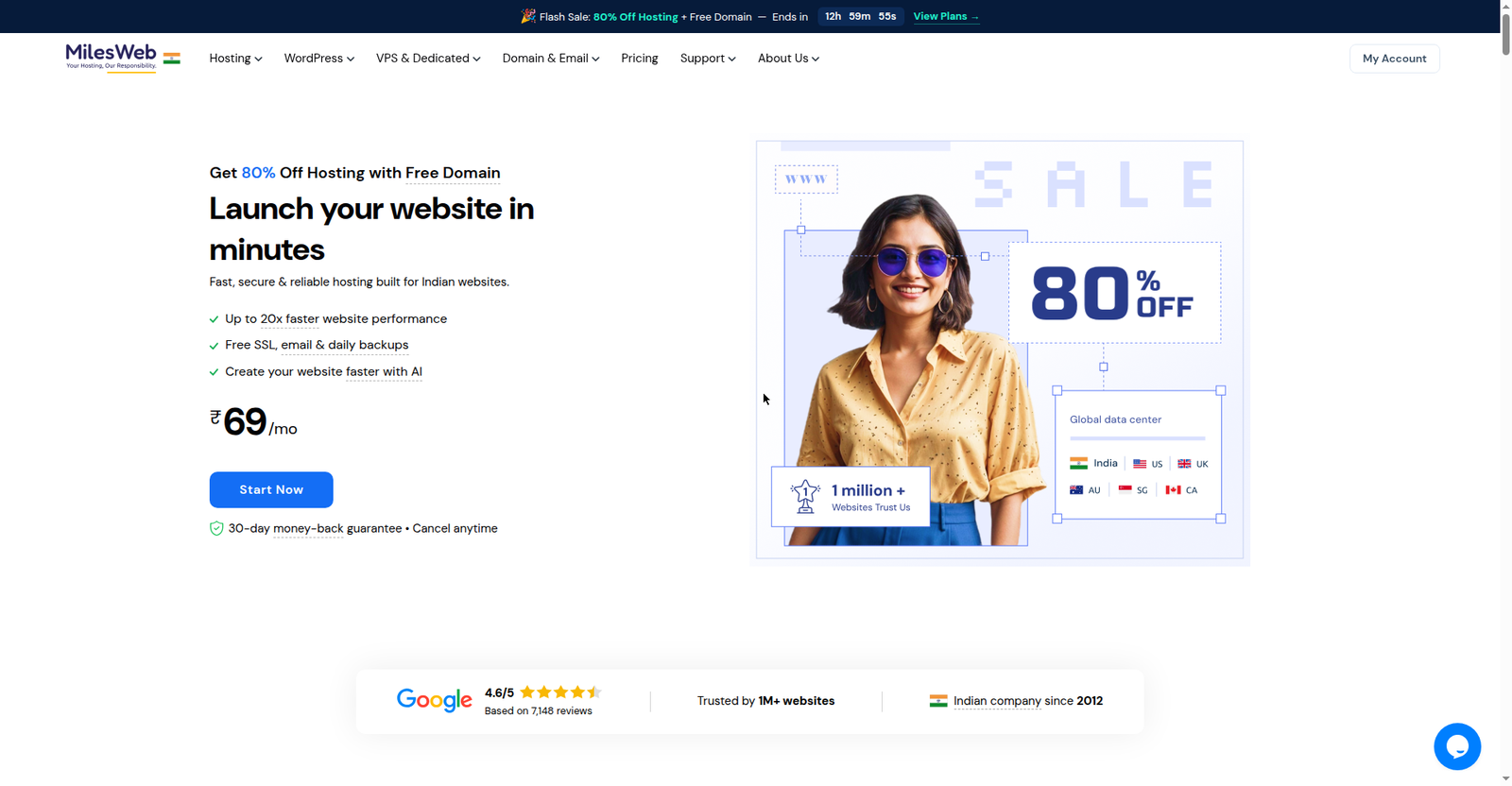 MilesWeb’s homepage — prices are displayed excluding 18% GST, with the same-renewal guarantee on shared plans
Pick 1: MilesWeb Advance — the cleanest option for GST paperwork (₹99/mo)
On the paperwork angle, this is the strongest option. MilesWeb’s official FAQ says it straight: displayed prices are GST-exclusive, 18% is added at checkout, a valid GST invoice comes with every purchase, and the GSTIN can be added at checkout or later through billing settings. For ITC purposes, that’s a documented process — not guesswork.
The plan itself is solid for a small business: 1 website, 15 GB NVMe storage, 2 email accounts, free SSL, daily backups, and a free domain in the first year. The biggest differentiator: the renewal price stays the same — ₹99/mo means ₹99/mo in year two and year three as well. Nothing simpler for budgeting.
Support is India-friendly too: 24/7 live chat, tickets, phone support, an India-based team, and the official page explicitly says “Support in English or Hindi”. For a non-technical business owner, phone plus Hindi support is real value.
Check the MilesWeb Advance plan — ₹99/mo with same-price renewal and a proper GST invoice.
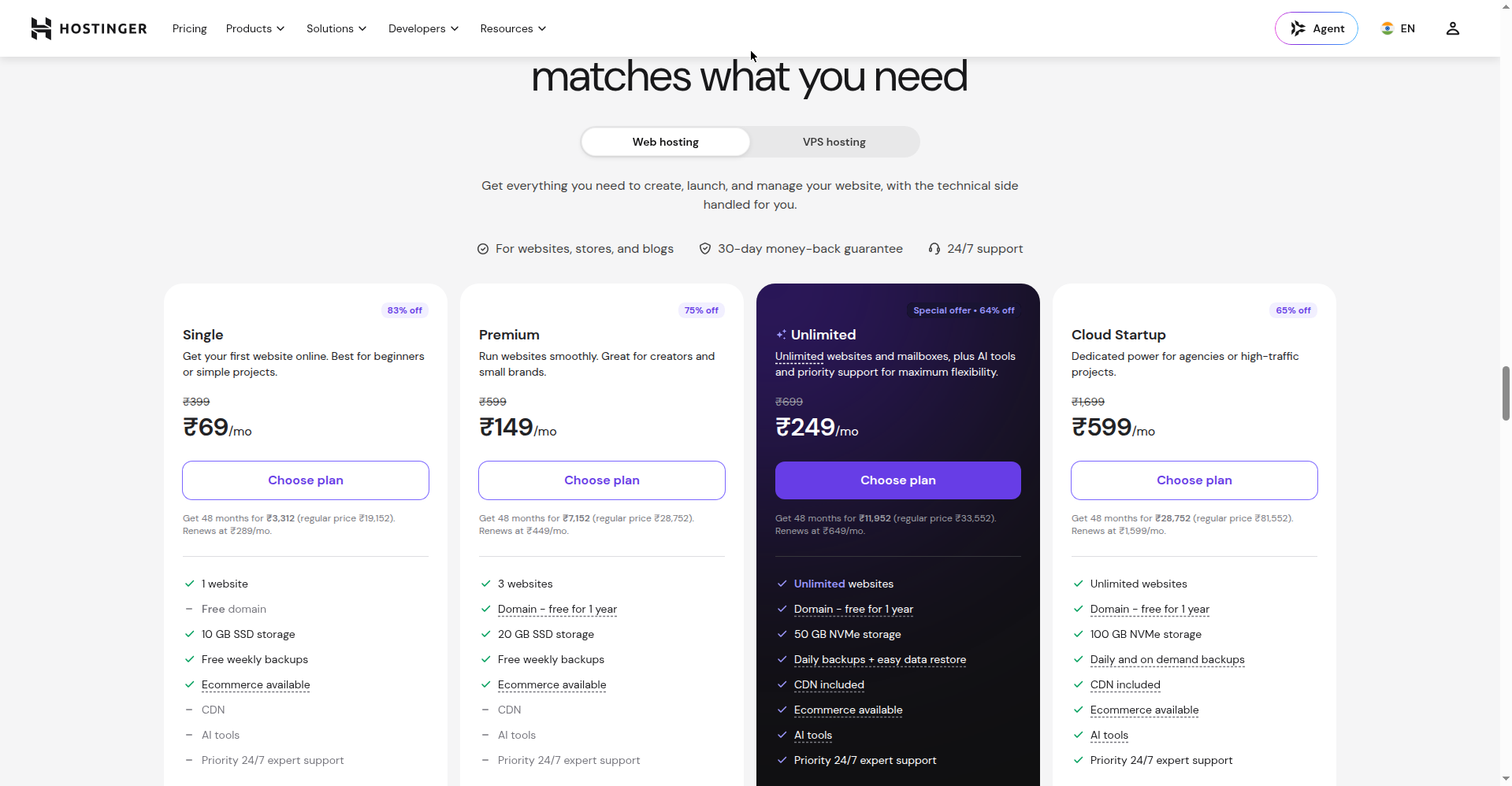 Hostinger India’s pricing page — intro prices are the lowest, but the renewal price is 3x higher
Pick 2: Hostinger Premium — the budget-first option, but budget the renewal first (₹149/mo intro)
If the goal is to keep year-one spending minimal, Hostinger Premium’s ₹149/mo intro (48-month term, ₹7,152 total) is the cheapest entry point. Three websites, 20 GB SSD, free domain for the first year, weekly backups — enough for a small business site.
But two honest warnings, both from verified data:
- The renewal jump: ₹149/mo renews at ₹449/mo — a 3x jump. Year two costs ₹5,388 + 18% GST = ₹6,358. The year-one saving evaporates in year two.
- The GST invoice process is based on third-party information: multiple third-party pages say displayed prices exclude GST and that GST-registered businesses can request a tax invoice via the “Tax Information” section with their GSTIN. We could not confirm this directly from the official India pricing page — verify this step yourself at signup.
Check the Hostinger Premium plan — lock the intro price on the 48-month term, but budget the renewal first.
 Bluehost India’s homepage — the brand is familiar, but the official page does not publish renewal prices
Pick 3: Bluehost India Basic — for brand familiarity (₹299/mo intro, 36-mo)
Bluehost India’s Basic plan is ₹299/mo intro on the 36-month term (1 website, 50 GB space, 5 email accounts), per bluehost.in’s official help page. On GST, two verified points: the official tax help page says 18% GST is collected from India customers, and a 2022 user receipt confirms the pattern — the checkout shows “THIS IS NOT A TAX INVOICE”, and then a final tax invoice is emailed after signup (billed as Endurance International Group India Pvt Ltd, with a proper GSTIN). The receipt is from 2022, so treat current-year specifics as third-party information — but the tax-invoice flow pattern is clear.
One gap that must be flagged: Bluehost India’s renewal price is not published on the official page — the page itself says promotions apply to the initial term. Year-two cost is unknown, so choose this plan only when brand familiarity or a specific reason matters.
Check Bluehost India’s plans — remember to save the tax invoice that arrives by email after signup.
Why these two didn’t make the shortlist
- HostGator India: their official site wasn’t even showing plan prices (blank placeholders), and there are unverified reports about their India business. Recommending without a verified price would break our honesty rule — so it’s excluded from this guide.
- A2 Hosting: billing is in USD with no documented Indian GST invoice flow. Not a fit for a GST-registered Indian small business.
The real cost: comparison with 18% GST included
This table shows displayed (pre-GST) prices alongside the 18% GST reality. The “Effective cost” column is for GST-registered businesses (after claiming ITC) — for non-registered or composition-scheme businesses, the “+GST” column is the final cost.
| Plan | Monthly (displayed) | Yearly cost (pre-GST) | +18% GST | Effective cost (GST-registered, after ITC) |
|---|---|---|---|---|
| MilesWeb Advance | ₹99 | ₹1,188 | ₹1,402 | ₹1,188 (same every year) |
| Hostinger Premium (intro, 48-mo) | ₹149 | ₹1,788 | ₹2,110 | ₹1,788 (first term only) |
| Hostinger Premium (renewal) | ₹449 | ₹5,388 | ₹6,358 | ₹5,388 |
| Bluehost Basic (intro, 36-mo) | ₹299 | ₹3,588 | ₹4,234 | ₹3,588 (renewal unknown) |
Two things stand out from the table. First: for a GST-registered business the 18% effectively drops to zero, so decide on the pre-GST column. Second: Hostinger’s intro is the cheapest, but it becomes the most expensive at renewal — MilesWeb’s flat ₹99/mo gives the lowest effective cost from year two onwards.
To calculate your total cost (domain + hosting, year by year), use our website cost calculator, and compare plans side-by-side in the hosting comparison tool. If you want the full picture of starting a blog, read the English version of our WordPress blog cost guide.
A 5-step checklist for buying hosting with GST compliance
- Keep your GSTIN ready before signup. Enter it in the billing/tax settings as you create the account — “I’ll do it later” is the most common and most expensive mistake.
- Verify the GST breakup at checkout. CGST 9% + SGST 9% (or IGST 18%) should be shown clearly. If you see only a lump-sum total, take a screenshot and confirm the tax invoice with support.
- Check your GSTIN on the first invoice. It must be printed on the invoice. If it’s missing, write to support immediately — corrections are easiest in the first billing cycle.
- Save every invoice and confirm ITC with your CA. Get your CA/accountant to verify the invoice is reflecting in your GSTR-2B — especially the first time.
- Write down the renewal price. Set a reminder for the renewal date. With hosts like Hostinger the renewal is 3x — that moment is when guides like our Hostinger plan comparison make it easy to re-evaluate.
Transparency note: the affiliate links in this article (MilesWeb, Hostinger, Bluehost India) may earn us a commission — Hostinger’s public affiliate programme pays up to $150 per sale. But our picks and price comparisons are based on verified public data; no host was favoured because of commission. Also read our disclosure on every article.